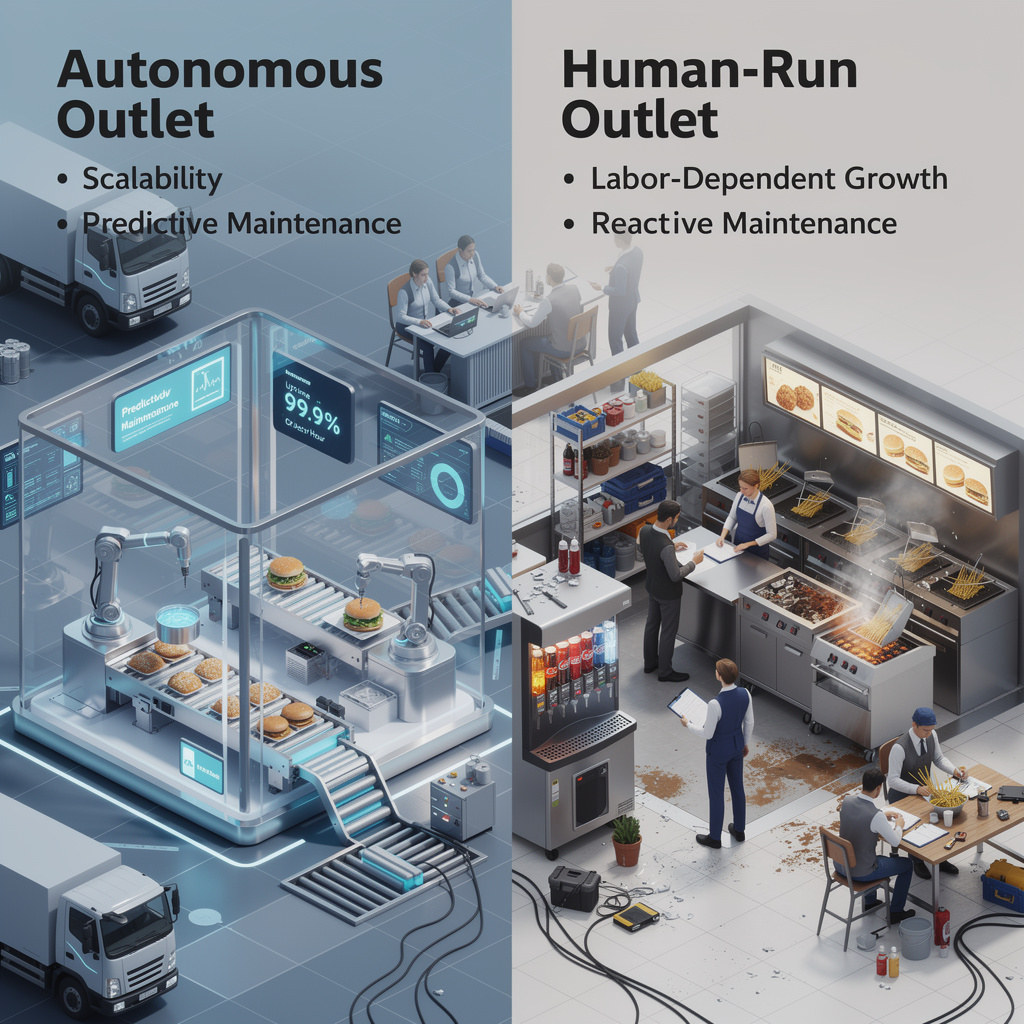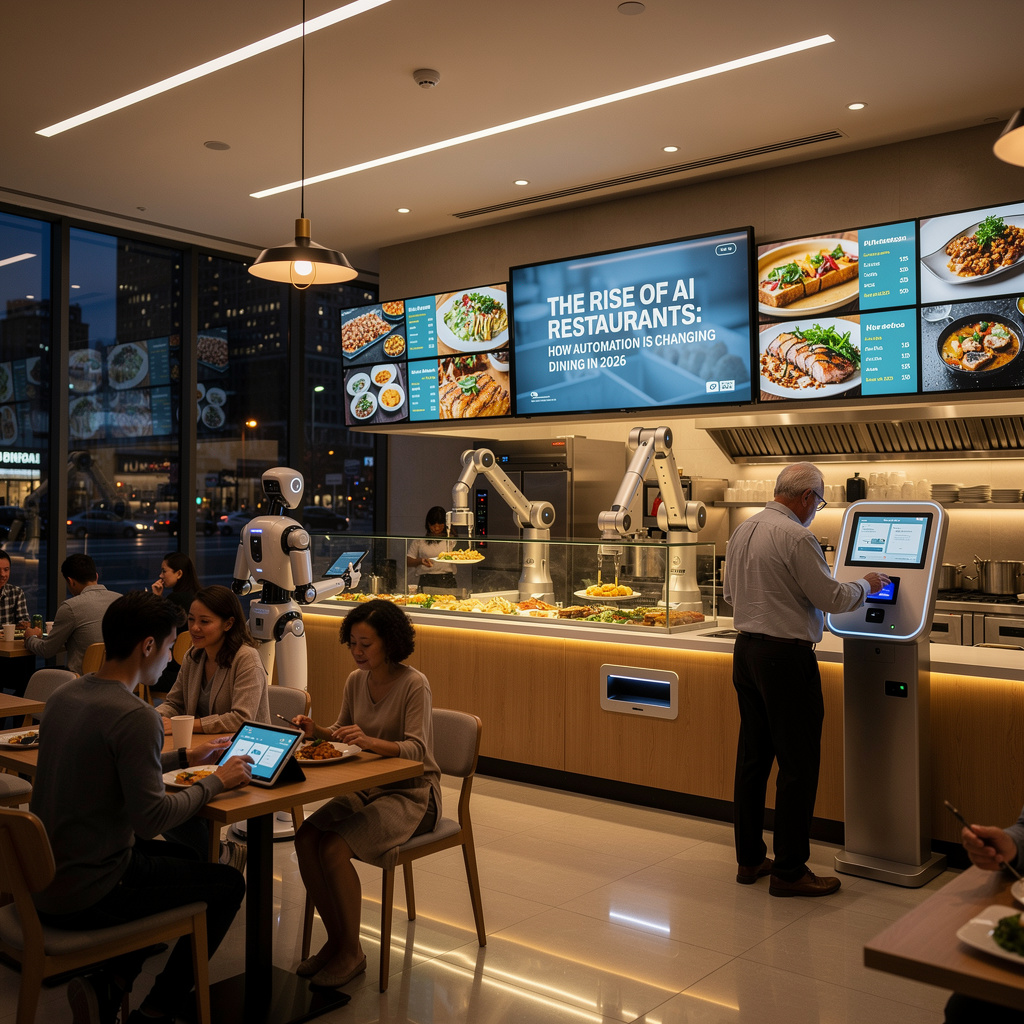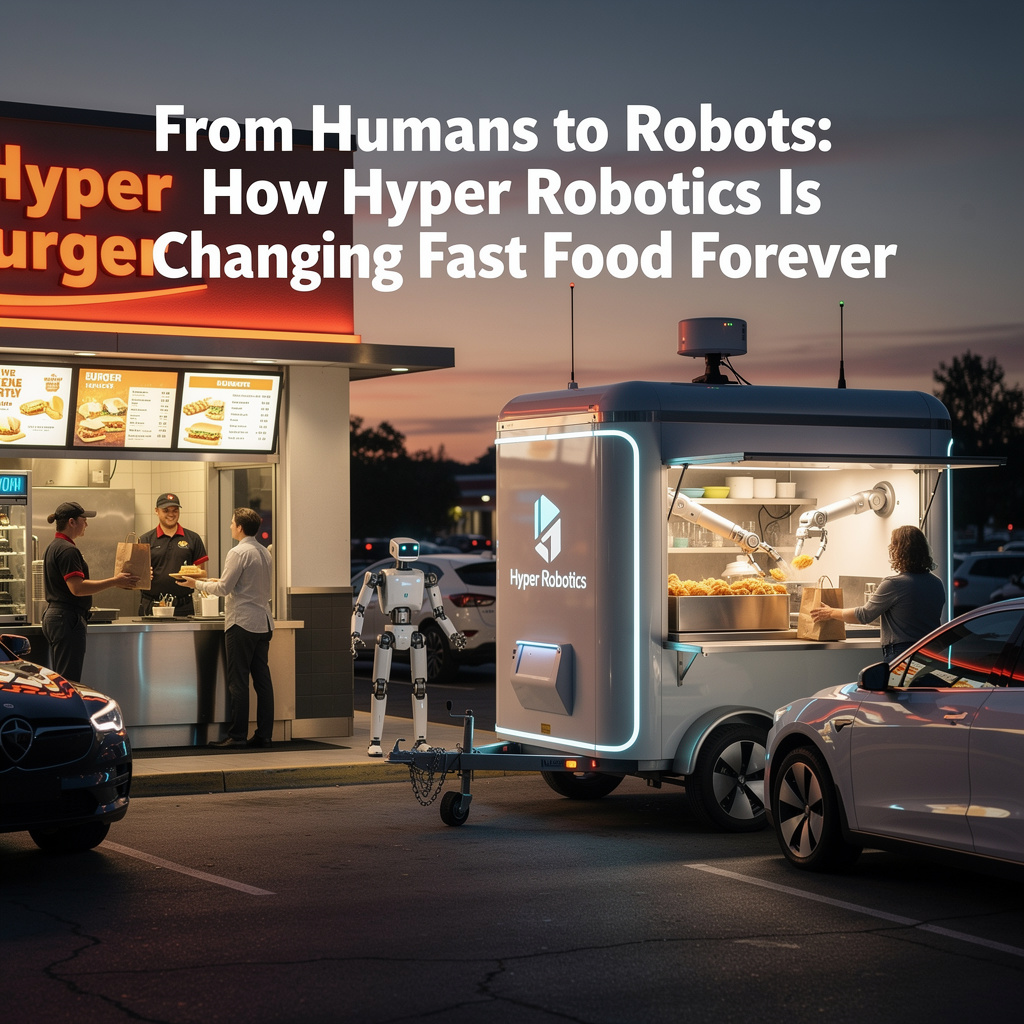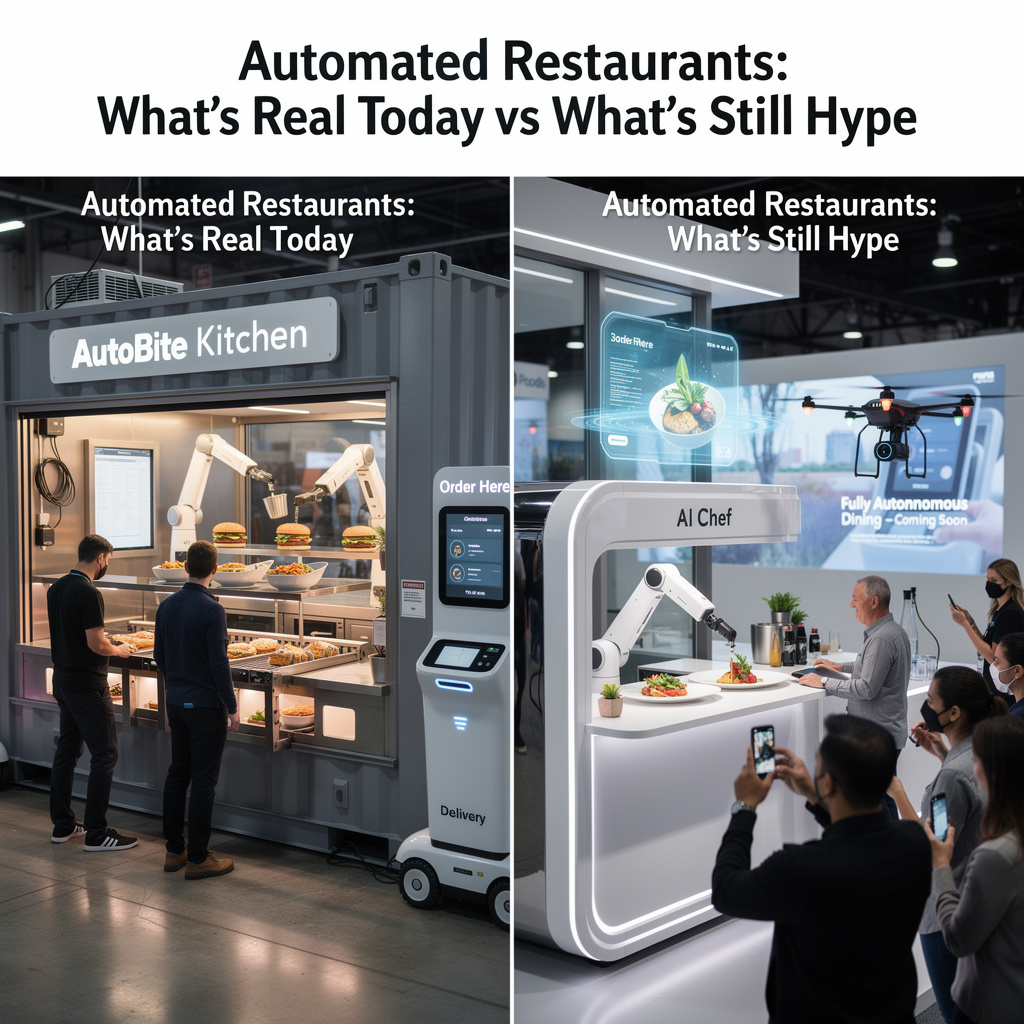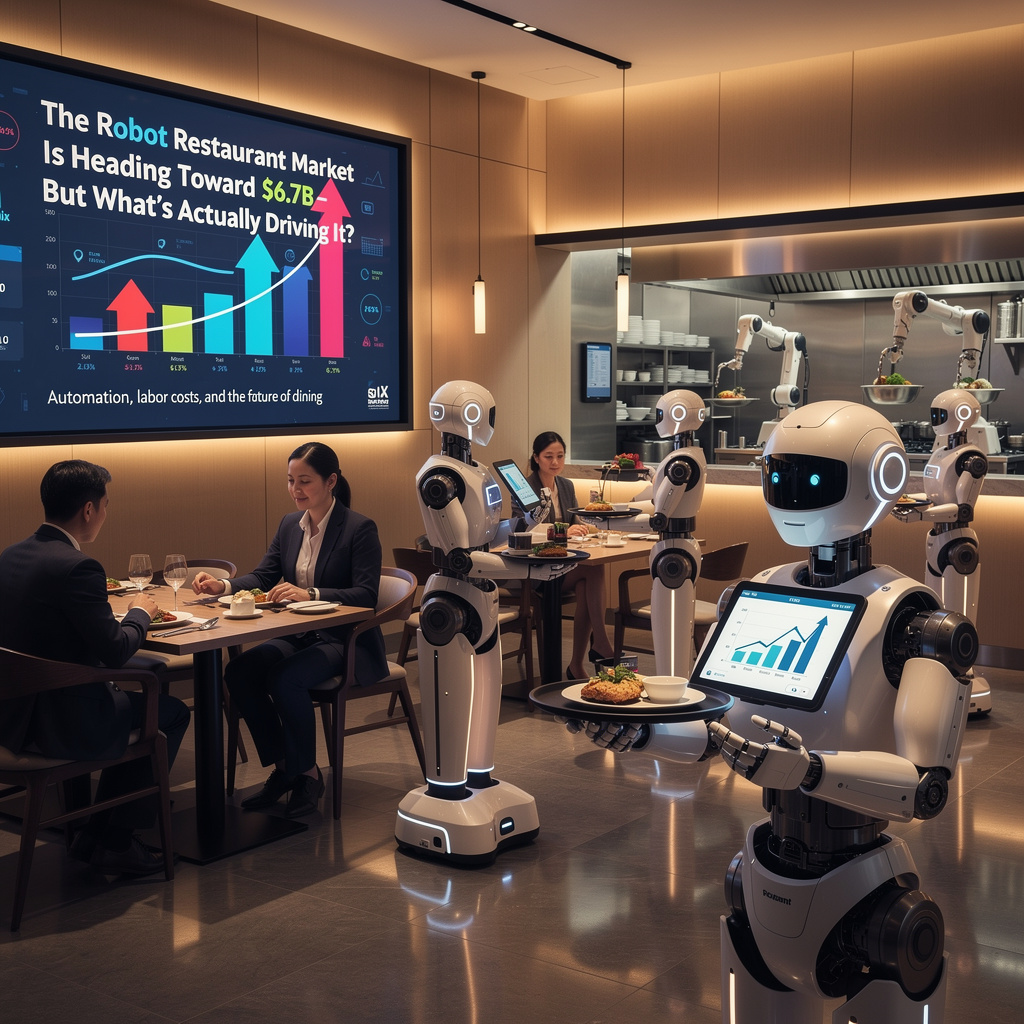
The robot-restaurant market is being driven by predictable forces, not hype. Rising labor costs, sustained delivery demand, tighter hygiene expectations, and improved machine vision and IoT are pushing fast food robots into enterprise deployments. Early pilots show measurable throughput, waste reduction, and labor displacement that justify pilot-to-scale playbooks for large QSRs.
Evidence from vendor pilots and industry forecasts shows the market moving into the billions. Smart rollouts focus on proven technology, ROI modeling, and cluster management rather than one-off experiments.
Table Of Contents
- Macro drivers behind the $6.7B momentum
- The technology that makes autonomous restaurants practical
- Unit economics and an ROI playbook
- Vertical use-cases: pizza, burgers, salads, ice cream
- Deployment, scaling, and risk controls
- Why enterprise buyers choose Hyper-Robotics
Macro Drivers Behind The $6.7B Momentum
Labor is the headline pressure. Many markets face high turnover and rising wages, which make monthly labor costs volatile. Automation reduces dependence on hourly labor and stabilizes OPEX. Delivery and off-premise demand is another major force. Consumers order more takeout and delivery outside peak hours. Delivery-first, autonomous units capture that demand without adding full-service staff or expensive real estate.
Hygiene and traceability remain priorities after the pandemic. Autonomous kitchens log temperature, cleaning cycles, and production steps, which reduces contamination risk and simplifies compliance for health inspectors. Sustainability and waste reduction also push adoption. Robotics enable precise portion control and demand-matched production, which cuts food waste and improves margins. Not all headwinds are gone. Public acceptance and upfront cost still limit some deployments. I
ndustry coverage highlights both the rising adoption and the lingering constraints around cost and customer comfort with contactless preparation. See recent automation trend reporting for more context. Market projections vary by model and scope. Some research groups show steady growth into the next decade, which aligns with the $6.7B figure many enterprise teams use for planning scenarios. For a broader market projection view, review analysis published at https://www.strategicrevenueinsights.com/blogs/restaurant-service-robot-market.
The Technology That Makes Autonomous Restaurants Practical
Autonomous Fast Food depends on a specific technology stack working together.
Machine vision, AI cameras, and dense sensor arrays verify assembly steps, detect product presence, and monitor temperatures. These control loops turn repeatable tasks into reliable, auditable processes.
Task-specific robotics handle the heavy lifting. Dough handling, precision dispensers, automated fryers, and pick-and-place systems reduce variability and speed production.
Edge-to-cloud software and cluster management allow centralized orchestration. Remote diagnostics and predictive maintenance limit downtime across many units, which makes a national rollout operationally feasible.
Food-safe materials and integrated self-sanitation reduce inspection friction. Combined with secure OTA updates and device authentication, the platform meets enterprise security and compliance requirements.
Hyper-Robotics’ knowledge base summarizes measured pilot outcomes and the key metrics teams should track during early tests. For pilot design and expected performance gains, see the guidance at https://www.hyper-robotics.com/knowledgebase/what-makes-autonomous-fast-food-delivery-restaurants-a-game-changer/.
Unit Economics And An ROI Playbook
Automation affects both cost and revenue lines.
- Labor savings and predictability
Partial substitution of hourly roles reduces monthly variability. Fewer unpredictable labor hours mean more predictable margins. - Waste reduction
Portion control and demand-matched production reduce spoilage. Integrated inventory forecasting reduces overproduction. - Throughput and accuracy
Faster assembly and fewer errors increase effective throughput. Higher throughput raises revenue during peak windows and improves delivery SLA performance. - Extended availability
Autonomous units can run long hours or operate 24/7 in many locations. That capability unlocks incremental orders without proportional labor costs. - Pilot-to-scale ROI playbook
Start with high-volume menu items. Measure orders per hour, average ticket, order accuracy, food cost variance, and uptime. Hyper-Robotics pilots have reported increases in peak throughput and reductions in food-cost variance and labor hours. Use site-level modeling to estimate payback, which often falls in the 18 to 30 month range depending on local labor and utilization. For measured pilot metrics and recommended KPIs, consult Hyper-Robotics’ pilot guidance.
Vertical Use-Cases: Pizza, Burgers, Salads, Ice Cream
- Pizza
Pizza benefits from high repeatability. Robotics handle dough stretching, sauce and topping dispensers, and oven timing to produce consistent pies at scale. Precision topping dispense and consistent bake profiles preserve brand quality while increasing throughput. - Burgers
Patty handling, searing, assembly, and hot-holding need heat-tolerant subsystems and precise timing. Robotics reduce variability and improve order accuracy for build-your-own and combo lines. - Salad bowls and fresh assembly
Salads require portion control and cold-chain integrity. Robotic dispensers and sensor-driven freshness checks lower waste and ensure consistent nutrition labeling per bowl. - Ice cream and soft-serve
Variable recipes and strict hygiene make automated dispensers attractive. Closed refrigeration monitoring and self-sanitizing nozzles reduce contamination risk and speed service.
Design each vertical stack to the menu. A one-size robotic arm rarely delivers the required economics for multiple cuisines, so reusable modular subsystems matter.
Deployment, Scaling, And Risk Controls
- Format choice
40-foot units give carry-out and delivery capacity with full production; 20-foot units serve dense delivery pockets as micro-fulfillment hubs. Choose format by catchment area, delivery density, and brand goals. - Cluster operations and orchestration
Run regional clusters to maximize maintenance efficiency and routing. Central analytics allocate capacity across units to reduce downtime impact and avoid underutilized assets. - Integrations
Tie robotic units into POS, loyalty, aggregator APIs, and ERP systems. Seamless order flow avoids customer friction and preserves back-office reporting. - Service-level agreements
SLA structure matters. Expect remote monitoring and OTA patching, scheduled preventive maintenance, and rapid on-site windowed repairs. Stock local spare parts to minimize mean time to repair. - Regulatory and security controls
Adopt HACCP-aligned processes and third-party food-safety verification for inspections. Harden IoT devices, encrypt telemetry, and maintain role-based access for operational staff.
Why Enterprise Buyers Choose Hyper-Robotics
Hyper-Robotics packages plug-and-play containerized units with enterprise software and services. The company emphasizes deployment speed, predictable installation, and cluster-grade operations. Real pilot metrics and a clear SLA-backed service model reduce procurement risk. Detailed pilot guidance, measurable KPIs, and a playbook for scaling help large QSRs make evidence-based decisions. For an overview of the rise of robotic fast-food restaurants in the US and market momentum, see https://www.hyper-robotics.com/knowledgebase/the-rise-of-robotic-fast-food-restaurants-in-the-us/.
Key Takeaways
- Pilot for measurable KPIs: track orders per hour, food-cost variance, order accuracy, and labor hours displaced.
- Pick formats by use case: 40-foot for carry-out and hub models, 20-foot for delivery-first micro-fulfillment.
- Build cluster operations early: centralized monitoring and predictive maintenance lower scaling costs.
- Integrate with POS and aggregators to protect revenue and reporting.
- Harden security and HACCP processes before enterprise rollouts.
FAQ
Q: How fast will a pilot prove ROI for a busy urban location?
A: A well-designed pilot can show directional ROI in 12 weeks and payback modeling in 18 to 30 months. Measure peak throughput, order accuracy, and food-cost variance. Use conservative utilization assumptions and include maintenance SLAs. Hyper-Robotics provides pilot templates that include the exact KPIs to track.
Q: What are the main barriers to consumer acceptance?
A: The primary barriers are perception and habit. Customers accept automation quickly if food quality and speed match or exceed staffed stores. Clear signage and a simple UX reduce friction. Early adopters show repeat purchases when the last-mile delivery and pickup experience is reliable.
Q: Can robotics handle perishable menu items and cold-chain requirements?
A: Yes. Designs include closed refrigeration monitoring, sensor-driven freshness checks, and portioning that preserves cold-chain integrity. Continuous temperature logs and HACCP-aligned cleaning cycles support both safety and traceability.
Q: What cybersecurity measures are needed for enterprise rollouts?
A: Enterprises should require device authentication, encrypted telemetry, role-based access, secure OTA updates, and SOC-ready logging. Regular penetration testing and third-party audits close gaps. Include these requirements in procurement and SLA contracts.
Q: How do you choose between 40-foot and 20-foot unit formats?
A: Choose 40-foot units when you need full production for both carry-out and delivery hubs. Choose 20-foot units for dense delivery pockets and quick pop-up coverage. Evaluate by delivery density, catchment population, and peak-hour demand.
Q: Are there use-cases where robotics is a poor fit?
A: High-touch, low-volume tasting experiences and restaurants that rely on complex, bespoke plating may not benefit initially. However, standardized menus with repeatable tasks are ideal for automation. Start with the highest-volume, repeatable items to prove value.
Would you like a custom ROI model or a pilot playbook for a specific region or brand?
About Hyper-Robotics
Hyper Food Robotics specializes in transforming fast-food delivery restaurants into fully automated units, revolutionizing the fast-food industry with cutting-edge technology and innovative solutions. We perfect your fast-food whatever the ingredients and tastes you require.
Hyper-Robotics addresses inefficiencies in manual operations by delivering autonomous robotic solutions that enhance speed, accuracy, and productivity. Our robots solve challenges such as labor shortages, operational inconsistencies, and the need for round-the-clock operation, providing solutions like automated food preparation, retail systems, kitchen automation and pick-up draws for deliveries.