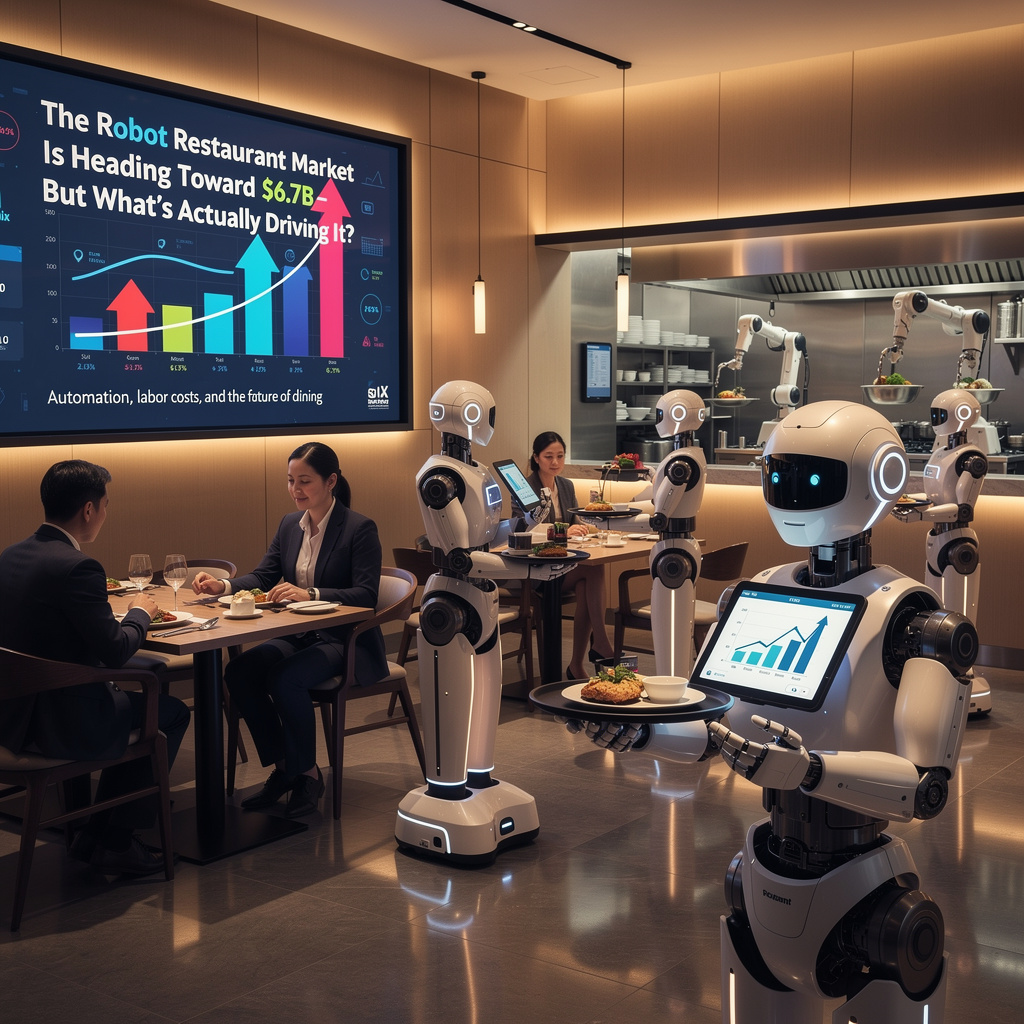
“Are you ready to eat from a robot tonight?”
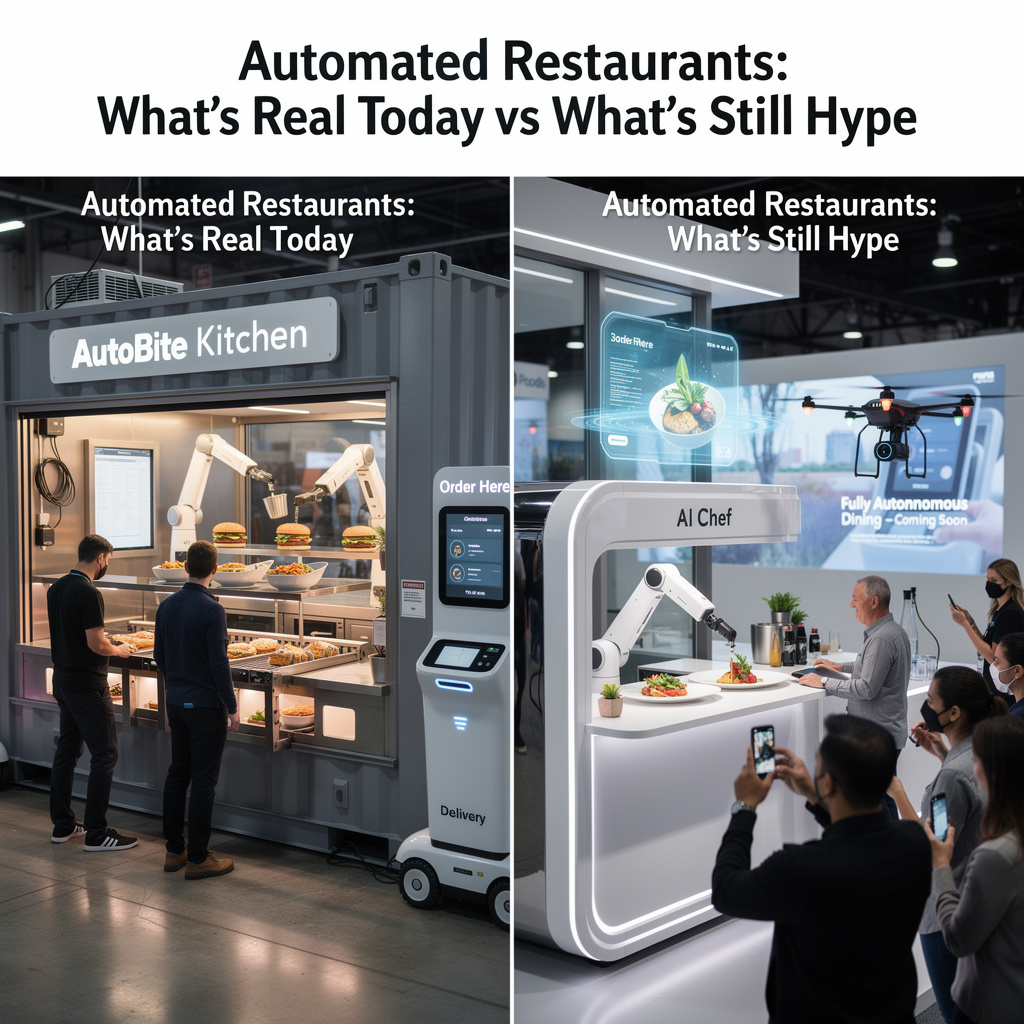
You should be ready to separate spectacle from substance. Kitchen robots, robotics in fast food, AI chefs and robot restaurants are real technologies you can evaluate now. Some automation delivers measurable gains in throughput, accuracy, hygiene and labor coverage. Other promises remain marketing gloss, like universal cooks that replace every human with zero maintenance and instant payback. This piece lays out what you can deploy today, what is still hype, and exactly how to run a pilot that proves value for a large QSR network.
Table of Contents
1. The State of Automated Restaurants Today
2. What’s Still Hype
3. Comparison Table: Real Today vs Still Hype
4. Axis 1 – Menu Complexity: Real Today then Still Hype
5. Axis 2 – Reliability and Maintenance: Real Today then Still Hype
6. Axis 3 – Food Quality and Sensory Parity: Real Today then Still Hype
7. Axis 4 – Integration and Operations: Real Today then Still Hype
8. Axis 5 – Regulatory and Franchise Fit: Real Today then Still Hype
9. Axis 6 – Commercial Model and ROI: Real Today then Still Hype
10. What to Evaluate in Vendors and Pilots
11. Key Takeaways
12. FAQ
13. Closing Questions
14. About Hyper-Robotics
The State Of Automated Restaurants Today
You should know the concrete wins before you commit. Task-specific robotics are proven in production for high-repeatability items. Robots reliably form dough, manage fry lines, dispense ice cream and assemble bowls at scale. Remote fleet orchestration and machine vision quality control are mature enough to run multi-unit deployments with centralized monitoring. Containerized, plug-and-play units shrink site build time and are commercially available for rapid rollout, as described in the Hyper-Robotics knowledge base on autonomous fast-food trends [Bots, restaurants, and automation in restaurants: 2026s fast-food revolution]. Industry coverage and expert panels also confirm that 2026 is the year many vendors and chains move beyond pilots to production, as noted in this QSR Magazine roundtable on next-generation restaurant tech [QSR Magazine: What’s next for restaurant tech in 2026?].
You should expect clear operational outcomes where automation fits the use case. Typical measurable improvements reported in pilot programs include higher throughput during peak delivery windows, lower order error rates through vision-based verification, and fewer food-safety incidents thanks to sensorized control. The trick is narrowing scope. When you match a robotic system to a narrow, high-volume menu, the business case becomes straightforward.
What’s Still Hype
You should also recognize the myths that vendors still use to win headlines. No vendor has a one-size-fits-all robot that flawlessly replicates all menu items and finishes, while requiring zero maintenance. Claims of instant payback without a full lifecycle cost analysis are suspect. Promises that automation will remove every regulatory hurdle are false, because local food codes, franchise agreements and labor laws still apply. Finally, universal consumer acceptance is not automatic. Customers notice texture and finishing touches; a technically working robot can still fail a blind taste test.
| Attribute | Real Today | Still Hype |
|---|---|---|
| Menu complexity supported | Limited to narrow, repeatable menus (pizza, bowls, dispensers) | Full-menu interchangeability across complex, customizable items |
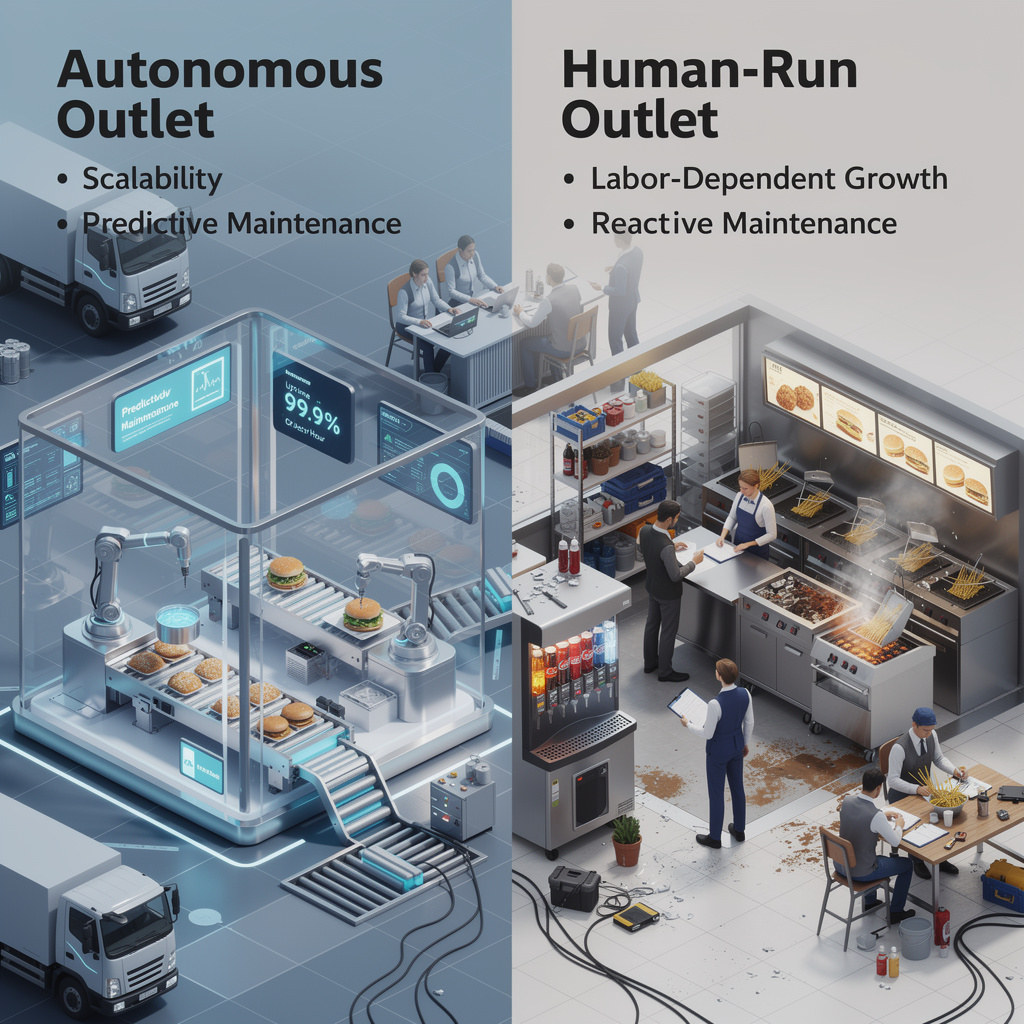
| Uptime and reliability | High for task-specific systems with SLAs (production pilots show multi-month runs) | Continuous operation with zero maintenance |
| Food quality parity | Good for portioning and repeatable cooking profiles | Indistinguishable from chef-finished items for every menu |
| Sanitation and allergen control | Sensorized cleaning routines and corrosion-free materials available | Never needs chemical cleaning and eliminates cross-contamination risk |
| Integration with legacy systems | APIs and POS integrations exist for enterprise deployments | Plugs into any legacy stack without customization |
| Scalability and economics | Clusterized fleets and predictive maintenance reduce marginal costs at scale | Guaranteed payback in a fixed number of months for every site |
Axis 1 – Menu Complexity: Real Today
You should start pilots with menus that are narrow and repeatable. Pizza, simple burgers, bowls, and soft-serve ice cream are classic fits. When a menu has few permutations, you can program motion primitives and thermal profiles once, then run thousands of consistent cycles. Vendors document production deployments that succeed under these constraints, and the Hyper-Robotics knowledge base provides deployment patterns and case examples to guide pilot design [Bots, restaurants, and automation in restaurants: 2026s fast-food revolution].

Axis 1 – Menu Complexity: Still Hype
You should not expect a single robotic system to handle a heavily customized menu with delicate finishing work. Finishes that require human judgment, like plating, texture adjustments and last-minute garnishes, remain challenging. Automation vendors often overstate their reprogramming speed and flexibility. In practice, adding a new menu item often triggers mechanical changes, new tooling and a round of validation.
Axis 2 – Reliability and Maintenance: Real Today
You should evaluate mean time between failures and the service model. Proven systems run with high uptime when supported by predictive maintenance, spare-part pools and remote triage. Cluster management software monitors sensors and can pre-empt failures, reducing emergency dispatches. Industry pilots commonly use a three to six month proof-of-concept to learn maintenance cadence and spare-part consumption before scaling.
Axis 2 – Reliability and Maintenance: Still Hype
You should not buy the promise of never servicing a machine. Zero maintenance is marketing. Expect scheduled maintenance, periodic part replacement and software updates. The real question is the cost and speed of that support, not whether support exists. Demand SLAs that spell out mean time to repair and on-site response times.
Axis 3 – Food Quality and Sensory Parity: Real Today
You should accept that automation excels at repeatable cooking profiles. Sensors and machine vision can control portion accuracy, temperature and assembly order. That improves consistency across locations, which many large chains prize for brand promise. Where texture and finish are less nuanced, customers accept robot-prepared items readily.
Axis 3 – Food Quality and Sensory Parity: Still Hype
You should be wary of claims that robot-made items are indistinguishable from a skilled human every time. Nuance in searing, melt and hand-finished presentation still advantage humans in sensory tests. Use blind taste panels in your pilots to assess whether the automated outcome meets your quality thresholds.
Axis 4 – Integration and Operations: Real Today
You should insist on API-level integrations. Modern robotic kitchens can integrate with POS, delivery platforms and inventory systems. Centralized analytics give you per-unit production metrics, waste logs and predictive maintenance data. QSR Magazine experts advise that integration is key for enterprise-scale adoption, so you should plan integration work up front [QSR Magazine: What’s next for restaurant tech in 2026?].
Axis 4 – Integration and Operations: Still Hype
You should not assume the robot will magically drop into an existing SOC and work with legacy POS without custom work. Integration often requires middleware, mapping of product SKUs and testing of order flows. Vendors that promise plug-and-play integration without a professional services plan are understating the work.
Axis 5 – Regulatory and Franchise Fit: Real Today
You should plan regulatory reviews as part of any deployment. Proven vendors provide sanitation protocols, certification guidance and documentation to support permitting. Containerized kitchens can simplify physical inspections because their designs are standardized. Industry write-ups note increased regulatory preparedness as a factor in moving pilots to production Robot restaurant automation trends and permitting guidance.
Axis 5 – Regulatory and Franchise Fit: Still Hype
You should not expect a one-size regulatory solution. Local health authorities will inspect equipment and processes. Franchise legal frameworks often mandate who controls operations and capital expenditures. The vendor should help you draft franchise addenda and SOPs.
Axis 6 – Commercial Model and ROI: Real Today
You should model TCO, not just capex. Real pilots show that savings come from labor substitution during constrained tasks, reduced waste, and consistent throughput for delivery windows. A credible vendor will give you site-level KPIs, pilot metrics and references for at least six to twelve months of live operation.
Axis 6 – Commercial Model and ROI: Still Hype
You should be skeptical of blanket payback claims. ROI depends on local labor costs, utilization, maintenance terms and service fees. Vendors that promise a single payback period for all sites are oversimplifying a complex calculus.
What To Evaluate In Vendors And Pilots
You should insist on metrics and references. Ask for production references for the exact configuration you plan to deploy, with uptime, order accuracy and service history. Demand details on sensor density, machine vision capabilities and cleaning protocols. Verify cybersecurity posture and data ownership. Build a hybrid fallback plan where human staff can cover degraded modes. Run a three to six month pilot that includes blind taste tests, throughput stress tests and maintenance logging. Take the Hyper-Robotics knowledge base as a starting blueprint while you demand enterprise SLAs from any vendor.

Key Takeaways
- Start narrow: pilot with high-repeatability menu items, such as pizza, bowls, and soft serve, to maximize early wins.
- Measure everything: throughput, uptime, order accuracy, waste, maintenance events and customer satisfaction must be recorded during the pilot.
- Demand real SLAs: mean time between failures, response times, spare-part strategy and software update cadence are non-negotiable.
- Integrate early: budget for POS and inventory integration and test end-to-end order flows before scaling.
- Plan hybrid operations: keep humans in the loop for exceptions, complex finishes and local regulatory steps.
FAQ
Q: How long should a pilot run before I decide to scale?
A: Run a pilot for three to six months. That timeframe lets you collect seasonal variation, maintenance cadence and customer feedback. Measure uptime, order accuracy, throughput and labor hours saved. Include blind taste tests and regulatory checks. Use the results to model TCO for a cluster rollout.
Q: Which menu items are best suited for automation first?
A: Pick items that are repeatable and have few permutations. Pizza base formation, automated fry lines, bowl assembly and soft-serve dispensers are typical. Items with delicate finishing or frequent customization should be deferred. Run a taste panel to confirm parity and a throughput stress test to verify peak performance.
Q: What do I need from a vendor contract?
A: You should require production references for similar deployments, detailed SLAs on uptime and repair times, a spare-part plan and clear data ownership terms. Ask for firmware and software update schedules and cybersecurity certifications. Include a phased roll clause, so you can expand after hitting agreed KPIs.
Q: How do I handle franchise and regulatory concerns?
A: Involve legal and operations early. The vendor should provide SOPs, sanitation documentation and permitting support. Draft franchise addenda that spell out capital costs, maintenance obligations and training. Validate the equipment with local health inspectors before a roll.
Next steps
You should feel clear about one thing as you plan next steps. Automation is not binary. It is a set of tools that deliver strong value when you use them where they match the problem. Narrow menus, heavy delivery volumes and standardized processes buy you real gains today. Universal, hands-off robot cooks that replace every human and never need service remain future promises, not facts. Now think about the last time you lost a shift to a staffing shortage, and imagine removing that vulnerability with a tested cluster of containerized units.
- Would you pilot in your highest-volume delivery market first, or in a dense urban cluster with complex labor rules?
- Would you accept 95 percent parity in taste if it delivered 30 percent lower peak wait times?
- Would you insist on a vendor-provided dashboard that shows real-time uptime and waste metrics?
About Hyper-Robotics
Hyper Food Robotics specializes in transforming fast-food delivery restaurants into fully automated units, revolutionizing the fast-food industry with cutting-edge technology and innovative solutions. We perfect your fast-food whatever the ingredients and tastes you require. Hyper-Robotics addresses inefficiencies in manual operations by delivering autonomous robotic solutions that enhance speed, accuracy, and productivity. Our robots solve challenges such as labor shortages, operational inconsistencies, and the need for round-the-clock operation, providing solutions like automated food preparation, retail systems, kitchen automation and pick-up draws for deliveries.