
The fast food industry is undergoing its most significant structural shift in a century. Robots are cooking burgers, autonomous units are operating without a single human on site, and AI is managing everything from inventory to food safety. This guide covers everything operators, investors, and industry watchers need to understand about where fast food automation stands today , and where it is headed.
Fast food automation is no longer a future trend. It is happening now, at scale, across the world’s largest chains and the smallest ghost kitchens alike. Labor costs are rising, customer expectations for speed and consistency are higher than ever, and the technology required to replace manual tasks has crossed the affordability threshold for operators of almost any size.
This guide covers what automation and robotics actually mean in a fast food context, which technologies are driving the shift, the real financial case for operators, what it means for the workforce, what fully autonomous restaurants look like, and what the industry will look like by 2030.
Table of contents
- What is fast food automation? (definitions and scope)
- The technologies driving the shift
- Automated kitchens: how they work in practice
- The financial case: costs, savings, and ROI
- Robots and the workforce: what actually happens to jobs
- Pros and cons of automation for fast food operators
- Fully autonomous restaurants: the 2026 reality
- What fast food will look like in 2030
- Frequently asked questions
- Key takeaways
1. What is fast food automation?
Fast food automation refers to the use of machines, robots, and AI-powered systems to perform tasks that were previously done by human workers – cooking, assembling, packaging, ordering, cleaning, and managing inventory. The scope ranges from a single piece of automated equipment (a robotic fryer, an AI ordering kiosk) to a fully autonomous kitchen unit that operates without any human staff on site.
The term is often used interchangeably with restaurant automation and food service robotics, but there are meaningful distinctions. Restaurant automation is the broader category, it covers everything from automated dishwashers to AI-powered scheduling software. Food service robotics specifically refers to physical robotic hardware that performs tasks. Fast food automation combines both, with a focus on high-volume, standardised food production where consistency and speed are paramount.
Three categories of automation are driving the most change in fast food right now:
- Front-of-house automation: AI-powered drive-through ordering, self-service kiosks, and robotic delivery systems.
- Back-of-house automation: Robotic cooking systems, automated fryers, burger assembly machines, and AI-controlled inventory management.
- Fully autonomous units: Self-contained kitchen modules (typically 20 feet or smaller) that require no human staff to produce and serve food.
For a deeper look at how restaurant automation is changing day-to-day operations, see our guide to how restaurant automation is creating a new era of food service.
2. The technologies driving the shift
Five underlying technologies have converged to make fast food automation practical and affordable at scale in 2025 and 2026.
Computer vision and AI
Modern kitchen robots use cameras and machine learning to identify food items, monitor cooking progress, detect contamination, and adjust cooking parameters in real time. AI-powered drive-through systems can read license plates, recognise returning customers, and process natural language orders with accuracy that now routinely exceeds human performance in controlled conditions.
Robotic arms and end-effectors
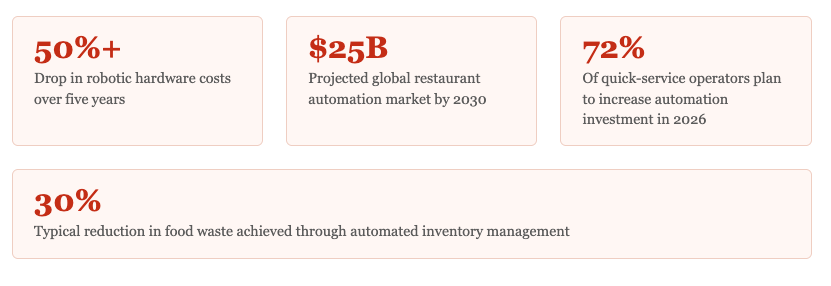
The physical hardware for food preparation has matured significantly. Purpose-built robotic arms can now handle the dexterity required for burger assembly, pizza topping, and burrito rolling, tasks that previously required human hands. The cost of these systems has dropped by more than 50% over the past five years, following a trajectory similar to industrial robotics in manufacturing.
IoT and edge computing
Connected kitchen equipment communicates in real time with inventory systems, supply chain software, and energy management platforms. Edge computing allows these systems to process data and make decisions locally , without cloud latency, which is critical for time-sensitive cooking processes.
Autonomous mobile robots (AMRs)
Delivery robots and in-restaurant food runners use LiDAR, cameras, and AI navigation to move safely through customer-facing environments. These systems are increasingly common in Asian markets and are expanding rapidly into US and European restaurant deployments.
Large language models for operations
AI systems now handle scheduling, demand forecasting, menu pricing optimisation, and customer service across multiple restaurant locations simultaneously. What previously required a dedicated operations team can be managed by a single AI platform integrated with point-of-sale and inventory data. For a detailed breakdown of how these technologies combine, see our overview of fast food robotics: the technology that will dominate.
3. Automated kitchens: how they work in practice
An automated kitchen is not simply a kitchen with one or two robotic tools added to a conventional setup. In its most advanced form, the kind now being deployed by companies like Hyper Robotics, an automated kitchen is an entirely different operating model: a self-contained unit that handles every step of food production, from raw ingredient storage to plated or packaged output, without human intervention.
The autonomous kitchen unit model
Hyper Robotics’ 20-foot autonomous kitchen unit is a practical example of this model operating today. The unit integrates robotic cooking hardware, AI-controlled food safety monitoring, automated cleaning systems, and a customer-facing ordering interface into a single deployable module. It can produce food 24 hours a day, seven days a week, with consistent quality across every unit produced.
This matters for operators because it decouples food production from the human staffing model entirely. You no longer need to hire, train, schedule, and manage a kitchen team. You need to manage a system, which is fundamentally different from managing people, and in most cases considerably less costly and complex. For a full look at how these units operate, see our piece on inside the autonomous kitchen where AI flips burgers 24/7.
Food consistency
One of the most underappreciated benefits of automated cooking is consistency. Human cooks vary – in technique, attention, and physical condition. A robotic cooking system produces the same result every time, to the same temperature, weight, and timing specification. For franchise operators whose brand value depends on consistent product quality across hundreds of locations, this is not a minor benefit. It is central to the business model.
For a detailed look at how this plays out in practice, see our guide on how automated cooking systems improve food consistency.
Food safety and hygiene
Automated kitchens eliminate several of the most common sources of food contamination: human handling errors, inadequate hand hygiene, and inconsistent temperature management. AI vision systems monitor food preparation in real time and flag anomalies before they become safety incidents. See our detailed analysis of how robotics improve food safety and the role of AI in hygiene.
4. The financial case: costs, savings, and ROI
The business case for fast food automation has changed fundamentally in the past three years. What was once a capital-intensive bet on future technology is now a financially defensible decision for operators of all sizes – and in many markets, the financially risky decision is not automating.
Labor cost reduction
Labor is typically the largest controllable cost in a fast food operation, representing 25–35% of revenue in most markets. A fully automated kitchen unit eliminates the majority of that cost. Even partial automation, robotic frying, automated ordering, can reduce labor requirements by 30–50% per shift. In markets where minimum wage has increased significantly (California, New York, UK, Australia), the payback period on automation hardware has shortened dramatically.
For a detailed breakdown of how these numbers work in practice, see our guide to how robotic automation reduces costs for fast food restaurants.
Revenue impact
Automation also affects the revenue side of the equation, not just costs. Consistent food quality drives higher customer satisfaction scores and repeat visits. Faster throughput means more customers served per hour, particularly during peak periods. 24/7 operation without staffing constraints opens revenue windows (late night, early morning) that are economically unviable with human labor. For the full analysis, see our research on how fast food automation reduces wait times and increases revenue.
Profit margin impact
The combined effect on margins is significant. Our analysis of the impact of automation on fast food profit margins found that operators with mature automation deployments are achieving EBITDA margins 8–15 percentage points higher than conventionally operated locations. That gap is expected to widen as labor costs continue to rise and automation hardware costs continue to fall. See also our 2025 analysis of AI and robotics profit margin impact for the near-term picture.
What nobody tells you about the cost savings
The headline cost saving (labor) is well understood. Less discussed are the secondary savings that compound over time: reduced food waste from precise portioning, lower workers’ compensation and HR overhead, reduced training costs (training a robot once versus training new human hires continuously), and lower insurance premiums in some markets. For an honest look at the full picture, see our piece on what nobody tells you about the cost savings of fully robotic restaurants.
Real ROI figures
Operators frequently ask what the actual payback period looks like. The answer depends on labor market conditions, volume, and the specific automation deployed, but for high-volume locations in markets with $15–$20/hour minimum wages, payback periods of 18–36 months are common. For a straight calculation, see our guide to what’s the real ROI of automating a fast food restaurant.
5. Robots and the workforce: what actually happens to jobs
This is the question the industry is most reluctant to answer directly. The honest answer is: automation does displace some jobs, creates some new ones, and changes many others. The net effect on employment in fast food is likely negative in headcount terms but more complex in economic terms.
Which jobs are most affected
The jobs most at risk from automation are the ones involving repetitive, high-volume, physically demanding tasks in a controlled environment: frying, grilling, assembly, and dishwashing. These are also, in most markets, the entry-level positions that have historically provided first employment for younger workers and recent immigrants.
AI-powered ordering systems are also displacing cashier roles, though this has been underway for a decade via self-service kiosks and is less dramatic than the kitchen automation story. For a full analysis, see our detailed piece on will robots replace workers in fast food and restaurant chains.
Which jobs are created or protected
Automation creates demand for robot technicians, AI systems managers, and operations specialists, roles that typically pay more than the positions they indirectly replace. Customer-facing, relationship-driven roles are more resilient, as are management positions that require judgment and context. The overall picture for the workforce is covered in depth in our analysis of what nobody tells you about automation’s impact on fast food employees.
Robots vs humans: the efficiency comparison
On pure speed and consistency metrics, robots already outperform humans on most repetitive cooking tasks. On judgment, adaptability, and customer interaction, humans still have significant advantages , though AI is eroding some of those advantages in predictable, scripted scenarios. For a head-to-head analysis, see our human workers vs robots: fast food efficiency showdown and our piece on whether a robot can cook better than a human.
The labor shortage context
The workforce debate often ignores a critical piece of context: fast food has had a severe and persistent labor shortage for years. In many markets, operators cannot hire enough workers even at elevated wages. Automation in this context is not simply replacing willing workers — it is filling a structural gap in labor supply. For the full picture, see can robotics in fast food solve labor shortages by 2030.
6. Pros and cons of automation for fast food operators
| Factor | Pro | Con / Consideration |
|---|---|---|
| Labor costs | Significant reduction in ongoing labor expense | High upfront capital or lease cost |
| Food consistency | Same result every time, across every location | Less flexibility for menu customisation |
| Food safety | AI monitoring reduces contamination risk | New failure modes (software errors, sensor failures) |
| Operating hours | 24/7 operation without staffing constraints | Maintenance windows still required |
| Speed | Higher throughput during peak periods | Setup and calibration time for new menu items |
| Scalability | Franchise expansion without proportional HR growth | Technical complexity of multi-site management |
| Workforce relations | Reduces exposure to labor disputes and turnover | Public perception and community relations risk |
| Maintenance | Predictable planned maintenance vs unpredictable human absence | Specialist technician dependency |
For a comprehensive review of both sides, see our dedicated guides on the pros and cons of automation in fast food chain restaurants and the pros and cons of robots in fast food restaurants. For the AI-specific angle, see the pros and cons of AI and robotics in fast food restaurants.
7. Fully autonomous restaurants: the 2026 reality
A fully autonomous fast food operation is no longer a concept or a pilot. It is a commercially deployed business model operating across multiple markets in 2026. Several distinct models have emerged.
The standalone autonomous unit
Self-contained kitchen modules – typically containerised, 20–40 feet in footprint – that operate without any human staff on site. They include robotic cooking hardware, automated ordering interfaces, and AI-managed food safety systems. Hyper Robotics’ autonomous kitchen unit is a representative example: deployable in a fraction of the time required to build a conventional restaurant, at significantly lower capital cost.
The ghost kitchen model
Automated production facilities that fulfil delivery orders without a customer-facing dining room. Ghost kitchens have been growing rapidly since 2020; automated ghost kitchens are the next iteration, removing the labor cost from a model that was already winning on location economics. For the business case, see why ghost kitchens and automation are the ultimate recipe for food delivery success.
The hybrid model
The most common deployment in 2026 is a hybrid: existing restaurant locations where automation handles high-volume, repetitive tasks (frying, grilling, ordering) while a reduced human team manages customer service, quality oversight, and exception handling. This model is lower risk for existing operators and provides a practical transition path. For what this looks like in a major chain context, see our analysis of the rise of robotic fast food restaurants in the US and how robotics is reshaping global fast food chains.
For a comprehensive operator’s guide to the fully autonomous model, see the complete guide to automated fast food outlets.
8. What fast food will look like in 2030
The next four years will be defined by acceleration, not invention. The technologies required for fully autonomous fast food are largely mature. What remains is the economic and regulatory work of deploying them at scale, and the competitive pressure that will force operators who have been hesitating to move.
The economic forcing function
Labor cost increases in major markets are not slowing down. Minimum wage in California is $20/hour for fast food workers, with further increases likely. Similar trajectories exist in the UK, Australia, Canada, and parts of Europe. Each wage increase improves the payback period on automation hardware. By 2030, in most high-wage markets, full kitchen automation will be the economically dominant choice for new site builds and major refits.
The competitive dynamic
Once a significant portion of the market automates, the operators who have not will face a structural cost disadvantage they cannot compete away through management quality alone. This is the pattern that played out in manufacturing, logistics, and retail. Fast food is following the same curve, roughly 10–15 years behind those industries.
What the customer experience looks like
The customer-facing change will be significant but not uniform. Drive-through AI ordering is already near-ubiquitous at major chains. Robotic food preparation is mostly invisible to customers, they interact with the output, not the process. Fully autonomous units with no human staff will be common for high-volume, simple-menu operations (pizza, burgers, coffee) by 2030. Full-service dining will remain human-dominated for longer, though even there automation will handle more of the back-of-house work.
For our full 2030 projection, see what will fast food restaurants look like in 2030 and why fully autonomous fast food restaurants will take over by 2030. For the kitchen technology specifically, see the future of AI-driven kitchens in the next five years.
9. Frequently asked questions
Q: Will robots replace all fast food workers?
Not all, and not quickly. Automation will displace the majority of kitchen production roles over the next 10–15 years in high-wage markets, but customer-facing, management, and technical maintenance roles will remain. The pace of displacement depends heavily on labor market conditions and the rate at which automation hardware costs continue to fall. The most honest answer is: yes, significantly, in most repetitive production roles; no, entirely, across the whole industry. See our detailed analysis of will robots replace workers in fast food chains.
Q: How much does fast food automation cost to implement?
Costs vary widely by automation type and deployment model. Individual pieces of automated kitchen equipment (robotic fryers, AI ordering systems) start from $30,000–$80,000. Fully autonomous kitchen units from providers like Hyper Robotics are available on lease models that eliminate the large upfront capital requirement and make automation accessible to operators without significant capital reserves. Payback periods in high-labor-cost markets typically run 18–36 months for mature deployments. For the full financial picture, see what’s the real ROI of automating a fast food restaurant.
Q: Which fast food chains are using robotics right now?
Most major chains have active automation deployments in 2026. McDonald’s has piloted AI-powered drive-throughs and automated frying at select locations. White Castle deployed Flippy burger-flipping robots across multiple sites. Sweetgreen uses robotic salad assembly. Chipotle has tested automated tortilla chip production and bowl assembly. For a full breakdown of companies and technologies, see our guide to the top robotics in fast food companies and top 10 fast food automation trends.
Q: Does automation improve food safety?
Yes, significantly, in most measurable areas. Human handling errors are a leading source of contamination in food service. Automated systems maintain consistent temperatures, eliminate cross-contamination risks from human contact, and use AI vision to monitor for anomalies in real time. The tradeoff is that software and sensor failures introduce new categories of risk that require their own management protocols. For the full picture, see how robotics improve food safety in kitchens.
Q: What does “autonomous restaurant” actually mean?
An autonomous restaurant is a food service operation that produces and serves food without requiring human staff to be present during operations. This includes automated cooking and assembly, AI-managed ordering and payment, robotic food delivery to the customer (or packaging for collection/delivery), and automated cleaning and maintenance cycles. As of 2026, several operators are running genuinely autonomous locations at commercial scale — not pilots. See automation in restaurants 2026: what kitchen robots mean for your meal.
Q: How does automation affect food quality?
Automation generally improves consistency and food safety while reducing the variation that comes from human cooking. The tradeoff is reduced flexibility — automated systems are optimised for standardised menu items and handle customisation less gracefully than human staff. For high-volume, standardised products (burgers, pizza, fried chicken), automation matches or exceeds human quality. For complex or highly customised orders, human judgment is still an advantage. See can a robot cook better than a human.
10. Key takeaways
- Fast food automation is not a future trend – it is a current commercial reality, deployed at scale by major chains and specialist operators alike.
- The financial case is strong and strengthening: labor cost increases in major markets are shortening payback periods on automation hardware every year.
- Fully autonomous kitchen units that operate without human staff now exist and are commercially viable, not just in pilots.
- Automation displaces some jobs, primarily in repetitive production roles, while creating new technical and management roles. The net effect on industry employment is likely negative in headcount terms but positive in wage terms for those who remain.
- By 2030, full kitchen automation will be the economically dominant model for new builds in high-labor-cost markets. Operators who have not planned for this face a structural cost disadvantage.
- Food safety and consistency are improved by automation in most measurable dimensions. Menu flexibility and handling of complex customisation remain areas where human skill still adds value.
